Regional growth, convergence, and spatial spillovers in India
A reproducible view from outer space
DOI:
https://doi.org/10.18335/region.v13i2.676Abstract
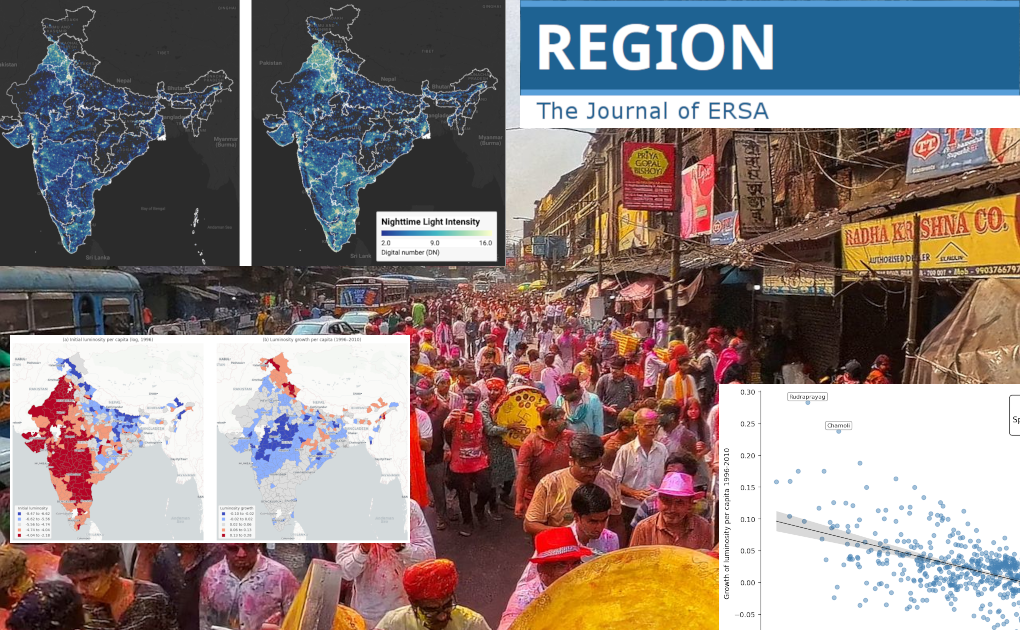
Using satellite nighttime light data as a proxy for economic activity, Chanda and Kabiraj (2020, World Development) studied regional growth and convergence across 520 districts in India. Adopting a reproducible open-science approach, this article builds on their work by extending their main findings on three empirical fronts. First, we illustrate regional convergence patterns using an interactive tool for satellite imagery visualization. Second, we assess the degree of spatial dependence in their main econometric specification. Third, we employ a spatial Durbin model to measure the role of spatial spillovers in the convergence process. Our results indicate that spatial spillovers increase the estimated speed of regional convergence. In our fully specified model, spillovers raise the convergence speed from about 3.0% to about 5.2% per year, which shortens the half-life of regional disparities from roughly 23 to 13 years. We close by illustrating how the same reproducible workflow extends beyond economic output, with an exploratory analysis of how luminosity relates to cultural participation across Indian states.
References
Abrahams A, Oram C, Lozano-Gracia N (2018) Deblurring DMSP nighttime lights: A new method using Gaussian filters and frequencies of illumination. Remote Sensing of Environment 210: 242--258. https://doi.org/10.1016/j.rse.2018.03.018
Abreu M, de Groot HLF, Florax RJGM (2005) A meta-analysis of $beta$-convergence: The legendary 2%. Journal of Economic Surveys 19: 389--420. https://doi.org/10.1111/j.0950-0804.2005.00253.x
Adhikari B, Dhital S (2021) Decentralization and regional convergence: Evidence from night-time lights data. Economic Inquiry 59: 1066--1088. https://doi.org/10.1111/ecin.12967
Allaire JJ, Teague C, Scheidegger C, Xie Y, Dervieux C (2024). Quarto.newblock urlhttps://quarto.org
Anselin L (1988) Spatial Econometrics: Methods and Models. Springer. https://doi.org/10.1007/978-94-015-7799-1
Anselin L (1995) Local indicators of spatial association---LISA. Geographical Analysis 27: 93--115. https://doi.org/10.1111/j.1538-4632.1995.tb00338.x
Asher S, Lunt T, Matsuura R, Novosad P (2021) Development research at high geographic resolution: An analysis of night-lights, firms, and poverty in India using the SHRUG open data platform. The World Bank Economic Review 35: 845--871. https://doi.org/10.1093/wber/lhab003
Asher S, Novosad P (2020) Rural roads and local economic development. American Economic Review 110: 797--823. https://doi.org/10.1257/aer.20180268
Barro RJ (2015) Convergence and modernisation. The Economic Journal 125: 911--942. https://doi.org/10.1111/ecoj.12247
Barro RJ, Sala-i-Martin X (1992) Convergence. Journal of Political Economy 100: 223--251. https://doi.org/10.1086/261816
Basher SA, Rashid S, Uddin MR (2023) Regional convergence in Bangladesh using night lights. Applied Economics Letters 30: 2581--2588. https://doi.org/10.1080/13504851.2022.2099798
Beyer RCM, Jain T, Sinha S (2023) Lights out? COVID-19 containment policies and economic activity. Journal of Asian Economics 85: 101589. https://doi.org/10.1016/j.asieco.2023.101589
Beyer RCM, Yamada T (2020) District-level convergence and public banks in India. SSRN Working Paper 3818578, Social Science Research Network. https://doi.org/10.2139/ssrn.3818578
Bickenbach F, Bode E, Nunnenkamp P, Söder M (2016) Night lights and regional GDP. Review of World Economics 152: 425--447. https://doi.org/10.1007/s10290-016-0246-0
Bluhm R, McCord GC (2022) What can we learn from nighttime lights for small geographies? measurement errors and heterogeneous elasticities. Remote Sensing 14: 1190. https://doi.org/10.3390/rs14051190
Carrington SJ, Jim'enez-Ayora P (2021) Shedding light on the convergence debate: Using luminosity data to investigate economic convergence in Ecuador. Review of Development Economics 25: 200--227. https://doi.org/10.1111/rode.12712
Caselli F, Esquivel G, Lefort F (1996) Reopening the convergence debate: A new look at cross-country growth empirics. Journal of Economic Growth 1: 363--389. https://doi.org/10.1007/BF00141044
Ch R, Martin DA, Vargas JF (2021) Measuring the size and growth of cities using nighttime light. Journal of Urban Economics 125: 103254. https://doi.org/10.1016/j.jue.2020.103254
Chakrabarty M, Mukherjee S (2022) Impact of COVID-19 on convergence in Indian districts. Indian Growth and Development Review 15: 198--209. https://doi.org/10.1108/igdr-11-2021-0152
Chakravarty P, Dehejia V (2017) Will GST exacerbate regional divergence? Economic and Political Weekly 52: 97--102.newblock urlhttps://www.epw.in/journal/2017/25-26/notes/will-gst-exacerbate-regional-divergence.html
Chanda A, Cook CJ (2022) Was India's demonetization redistributive? Insights from satellites and surveys. Journal of Macroeconomics 73: 103438. https://doi.org/10.1016/j.jmacro.2022.103438
Chanda A, Kabiraj S (2020) Shedding light on regional growth and convergence in India. World Development 133: 104961. https://doi.org/10.1016/j.worlddev.2020.104961
Chen X, Nordhaus WD (2011) Using luminosity data as a proxy for economic statistics. Proceedings of the National Academy of Sciences 108: 8589--8594. https://doi.org/10.1073/pnas.1017031108
Chen X, Nordhaus WD (2019) VIIRS nighttime lights in the estimation of cross-sectional and time-series GDP. Remote Sensing 11: 1057. https://doi.org/10.3390/rs11091057
Chen Y, Ursavacs U, Mendez C (2024) Can higher-quality nighttime lights predict sectoral GDP across subnational regions? Urban and rural luminosity across provinces in T"urkiye. Letters in Spatial and Resource Sciences 17: 12. https://doi.org/10.1007/s12076-024-00375-x
Chiovelli G, Michalopoulos S, Papaioannou E, Regan T (2026) Illuminating the Global South. The Economic Journal. https://doi.org/10.1093/ej/ueaf134
Cook CJ, Shah M (2022) Aggregate effects from public works: Evidence from India. Review of Economics and Statistics 104: 797--806. https://doi.org/10.1162/rest_a_00993
Diop S (2018) Convergence and spillover effects in Africa: A spatial panel data approach. Journal of African Economies 27: 274--284. https://doi.org/10.1093/jae/ejx027
Donaldson D, Storeygard A (2016) The view from above: Applications of satellite data in economics. Journal of Economic Perspectives 30: 171--198. https://doi.org/10.1257/jep.30.4.171
Durlauf SN, Johnson PA (1995) Multiple regimes and cross-country growth behaviour. Journal of Applied Econometrics 10: 365--384. https://doi.org/10.1002/jae.3950100404
Elvidge CD, Baugh KE, Zhizhin M, Hsu FC, Ghosh T (2017) VIIRS night-time lights. International Journal of Remote Sensing 38: 5860--5879. https://doi.org/10.1080/01431161.2017.1342050
Ertur C, Koch W (2007) Growth, technological interdependence and spatial externalities: Theory and evidence. Journal of Applied Econometrics 22: 1033--1062. https://doi.org/10.1002/jae.963
Fischer MM (2011) A spatial Mankiw-Romer-Weil model: Theory and evidence. Annals of Regional Science 47: 419--436. https://doi.org/10.1007/s00168-010-0384-6
Gennaioli N, La Porta R, Lopez-de-Silanes F, Shleifer A (2014) Growth in regions. Journal of Economic Growth 19: 259--309. https://doi.org/10.1007/s10887-014-9105-9
Gibson J, Olivia S, Boe-Gibson G, Li C (2021) Which night lights data should we use in economics, and where? Journal of Development Economics 149: 102602. https://doi.org/10.1016/j.jdeveco.2020.102602
Glawe L, Mendez C (2025) Harmonized luminosity and economic activity across provinces in China: Cross-sectional differences, regional time series, and inequality dynamics. Applied Economics 57: 10677--10693. https://doi.org/10.1080/00036846.2024.2439583
Gorelick N, Hancher M, Dixon M, Ilyushchenko S, Thau D, Moore R (2017) Google Earth Engine: Planetary-scale geospatial analysis for everyone. Remote Sensing of Environment 202: 18--27. https://doi.org/10.1016/j.rse.2017.06.031
Hasan R, Jiang Y, Rafols RM (2021) Place-based preferential tax policy and industrial development: Evidence from India's program on industrially backward districts. Journal of Development Economics 150: 102621. https://doi.org/10.1016/j.jdeveco.2020.102621
Henderson JV, Storeygard A, Weil DN (2012) Measuring economic growth from outer space. American Economic Review 102: 994--1028. https://doi.org/10.1257/aer.102.2.994
Isla-Castillo F, Garashchuk A, Podadera-Rivera P (2024) Cross-sectional and spatial panel data analysis of territorial economic cohesion in the European Union regions based on convergence approach: From 2 to 8 per cent? Socio-Economic Planning Sciences 95: 102012. https://doi.org/10.1016/j.seps.2024.102012
Jean N, Burke M, Xie M, Davis WM, Lobell DB, Ermon S (2016) Combining satellite imagery and machine learning to predict poverty. Science 353: 790--794. https://doi.org/10.1126/science.aaf7894
Jha P, Talathi K (2024) Impact of colonial institutions on economic growth and development in India: Evidence from night-lights data. Economic Development and Cultural Change 72: 1653--1708. https://doi.org/10.1086/725058
Jhamb P, Ferreira S, Stephens P, Sundaram M, Wilson J (2025) Shedding light on development: Leveraging the new nightlights data to measure economic progress. PLOS ONE 20: e0318482. https://doi.org/10.1371/journal.pone.0318482
Kacou KYT (2022) Interregional inequality in Africa, convergence, and multiple equilibria: Evidence from nighttime light data. Review of Development Economics 26: 918--940. https://doi.org/10.1111/rode.12851
Keola S, Andersson M, Hall O (2015) Monitoring economic development from space: Using nighttime light and land cover data to measure economic growth. World Development 66: 322--334. https://doi.org/10.1016/j.worlddev.2014.08.017
Khoun T, Poortinga A, Thwal NS, Gonz'alez de Alba I, McMahon A, Mendez C (2025) Mapping the dimensions of poverty through big data, socioeconomic surveys and machine learning in Cambodia. Social Indicators Research 180: 1593--1618. https://doi.org/10.1007/s11205-025-03718-3
Kluyver T, Ragan-Kelley B, P'erez F, Granger B, Bussonnier M, Frederic J, Kelley K, Hamrick J, Grout J, Corlay S et al. (2016) Jupyter notebooks---a publishing format for reproducible computational workflows. In: Schmidt B, Loizides F (eds), Positioning and Power in Academic Publishing: Players, Agents and Agendas. IOS Press, Amsterdam, NL, 87--90
Knuth DE (1984) Literate programming. The Computer Journal 27: 97--111. https://doi.org/10.1093/comjnl/27.2.97
LeSage JP, Pace RK (2009) Introduction to Spatial Econometrics. Chapman and Hall/CRC. https://doi.org/10.1201/9781420064254
Lessmann C, Seidel A (2017) Regional inequality, convergence, and its determinants: A view from outer space. European Economic Review 92: 110--132. https://doi.org/10.1016/j.euroecorev.2016.11.009
Li X, Zhou Y, Zhao M, Zhao X (2020) A harmonized global nighttime light dataset 1992--2018. Scientific Data 7: 168. https://doi.org/10.1038/s41597-020-0510-y
Lolayekar AP, Mukhopadhyay P (2019) Spatial dependence and regional income convergence in India (1981--2010). GeoJournal 84: 851--864. https://doi.org/10.1007/s10708-018-9893-0
McCallum I, Kyba CCM, Bayas JCL, Moltchanova E, Cooper M, Cuaresma JC, Pachauri S, See L, Danylo O, Moorthy I, Lesiv M, Baugh K, Elvidge CD, Hofer M, Fritz S (2022) Estimating global economic well-being with unlit settlements. Nature Communications 13: 2459. https://doi.org/10.1038/s41467-022-30099-9
Mellander C, Lobo J, Stolarick K, Matheson Z (2015) Night-time light data: A good proxy measure for economic activity? PLOS ONE 10: e0139779. https://doi.org/10.1371/journal.pone.0139779
Min B, Gaba KM, Sarr OF, Agalassou A (2013) Detection of rural electrification in Africa using DMSP-OLS night lights imagery. International Journal of Remote Sensing 34: 8118--8141. https://doi.org/10.1080/01431161.2013.833358
Miranti RC, Mendez C (2023) Social and economic convergence across districts in Indonesia: A spatial econometric approach. Bulletin of Indonesian Economic Studies 59: 421--445. https://doi.org/10.1080/00074918.2022.2071415
Moran PAP (1950) Notes on continuous stochastic phenomena. Biometrika 37: 17--23. https://doi.org/10.2307/2332142
Patnaik A, Mendez C (2024) Exploring economic activity from outer space: A Python notebook for processing and analyzing satellite nighttime lights. REGION 11: 79--109. https://doi.org/10.18335/region.v11i1.493
Peng RD (2011) Reproducible research in computational science. Science 334: 1226--1227. https://doi.org/10.1126/science.1213847
Pinkovskiy M, Sala-i-Martin X (2016) Lights, camera, income! illuminating the national accounts-household surveys debate. Quarterly Journal of Economics 131: 579--631. https://doi.org/10.1093/qje/qjw003
Quah DT (1996) Twin peaks: Growth and convergence in models of distribution dynamics. The Economic Journal 106: 1045--1055. https://doi.org/10.2307/2235377
Rey SJ, Montouri BD (1999) US regional income convergence: A spatial econometric perspective. Regional Studies 33: 143--156. https://doi.org/10.1080/00343409950122945
Sala-i-Martin X (1996) Regional cohesion: Evidence and theories of regional growth and convergence. European Economic Review 40: 1325--1352. https://doi.org/10.1016/0014-2921(95)00029-1
Santos-Marquez F, Gunawan AB, Mendez C (2022) Regional income disparities, distributional convergence, and spatial effects: Evidence from Indonesian regions 2010--2017. GeoJournal 87: 2373--2391. https://doi.org/10.1007/s10708-021-10377-7
Sanyal S, Arora A (2024) Relative economic performance of Indian states: 1960-61 to 2023-24. Working Paper EAC-PM/WP/31/2024, Economic Advisory Council to the Prime Minister
Shenoy A (2018) Regional development through place-based policies: Evidence from a spatial discontinuity. Journal of Development Economics 130: 173--189. https://doi.org/10.1016/j.jdeveco.2017.10.001
Solow RM (1956) A contribution to the theory of economic growth. Quarterly Journal of Economics 70: 65--94. https://doi.org/10.2307/1884513
Suleiman H, Nguyen MTT, Mendez C (2025) Predicting subnational GDP in Vietnam with remote sensing data: A machine learning approach. Letters in Spatial and Resource Sciences 18: 5. https://doi.org/10.1007/s12076-025-00397-z
Tamiminia H, Salehi B, Mahdianpari M, Quackenbush LJ, Adeli S, Brisco B (2020) Google Earth Engine for geo-big data applications: A meta-analysis and systematic review. ISPRS Journal of Photogrammetry and Remote Sensing 164: 152--170. https://doi.org/10.1016/j.isprsjprs.2020.04.001
Tipayalai K, Mendez C (2024) Regional convergence and spatial dependence in Thailand: Global and local assessments. Journal of the Asia Pacific Economy 29: 693--720. https://doi.org/10.1080/13547860.2022.2041286
Tubadji A (2025) Cultural entropy, innovation, and growth. Politics & Policy 53: e70050. https://doi.org/10.1111/polp.70050
Ursavas U, Mendez C (2023) Regional income convergence and conditioning factors in Turkey: Revisiting the role of spatial dependence and neighbor effects. Annals of Regional Science 71: 363--389. https://doi.org/10.1007/s00168-022-01168-0
Witmer FDW, O'Loughlin J (2011) Detecting the effects of wars in the Caucasus regions of Russia and Georgia using radiometrically normalized DMSP-OLS nighttime lights imagery. GIScience & Remote Sensing 48: 478--500. https://doi.org/10.2747/1548-1603.48.4.478
Downloads
Published
How to Cite
Issue
Section



License
Copyright (c) 2026 Carlos Mendez, Sujana Kabiraj, Jiaqi Li

This work is licensed under a Creative Commons Attribution 4.0 International License.
REGION is an open journal, and uses the standard Creative Commons license: Copyright We want authors to retain the maximum control over their work consistent with the first goal. For this reason, authors who publish in REGION will release their articles under the Creative Commons Attribution license. This license allows anyone to copy and distribute the article provided that appropriate attribution is given to REGION and the authors. For details of the rights authors grant users of their work, see the "human-readable summary" of the license, with a link to the full license. (Note that "you" refers to a user, not an author, in the summary.) Upon submission, the authors agree that the following three items are true: 1) The manuscript named above: a) represents valid work and neither it nor any other that I have written with substantially similar content has been published before in any form except as a preprint, b) is not concurrently submitted to another publication, and c) does not infringe anyone’s copyright. The Author(s) holds ERSA, WU, REGION, and the Editors of REGION harmless against all copyright claims. d) I have, or a coauthor has, had sufficient access to the data to verify the manuscript’s scientific integrity. 2) If asked, I will provide or fully cooperate in providing the data on which the manuscript is based so the editors or their assignees can examine it (where possible) 3) For papers with more than one author, I as the submitter have the permission of the coauthors to submit this work, and all authors agree that the corresponding author will be the main correspondent with the editorial office, and review the edited manuscript and proof. If there is only one author, I will be the corresponding author and agree to handle these responsibilities.